Categories Garage Door Tips

When a Simple Fix Isn’t Enough: Clear Signs You Need a New Garage Door

signs you need a new garage door

It’s tempting to put off large home expenses, and when your garage door acts up, the default solution is usually to call for a quick fix. However, there comes a point when continuous minor repairs cease to be cost-effective. Recognizing the definitive signals that a simple component replacement won’t suffice is crucial for homeowners looking to secure their property, save money, and boost curb appeal. Knowing the signs means you can confidently move toward a long-term solution: investing in a new garage door.

Age and Frequent Breakdowns: A Worn-Out System

The lifespan of a typical garage door is finite. While maintenance can extend its years, age eventually catches up to the entire system. If you are constantly calling for a technician, your door is likely nearing retirement.

The Door is Beyond 20 Years Old

Most quality garage doors are built to last 15 to 30 years. If your door is approaching or has exceeded the 20-year mark, you are likely dealing with hardware that has exceeded its cycle count. This includes fatigued springs, rusted cables, worn rollers, and a strained opener. The entire system is running on borrowed time, making a full garage door replacement a safer and more economical choice than continuous patching.

The Breakdowns Are Becoming Chronic

Have you replaced the springs last year, the cables this year, and now the panels are warping? A cycle of recurring garage door problems is one of the clearest signs you need a new garage door. The cumulative cost of these constant repairs often quickly surpasses the price of installing a dependable, new garage door that comes with a fresh warranty. Stop paying for the same problem in different places.

Visual and Structural Compromises

A garage door’s function is security and protection. When its structural integrity is compromised, it becomes a liability that repair cannot safely address.

Warped, Cracked, or Rotted Panels

Damage to the door panels is a significant threat to security and energy efficiency. For wood doors, moisture can lead to rot and structural weakness. For steel doors, deep rust, warping, or multiple large dents cannot be fully reversed. If more than two panels are extensively damaged, attempting individual panel replacement is often difficult (due to color/style matching) and expensive. This is a definitive sign it’s time for replacing a garage door.

Sagging or Operating Unevenly

If your door hangs crookedly, sags in the middle, or jerks violently when moving, it indicates major structural weakness. This often means the integrity of the tracks, the hardware mounts, or even the door frame itself is compromised. A persistent, unevenly operating or broken garage door poses a significant safety risk from sudden failure. Don’t wait for a complete collapse; prioritize a new garage door installation.

Safety and Security Deficiencies

Modern garage doors are designed with safety and security features that older models simply lack. Upgrading can save lives and protect your assets.

Missing or Failing Safety Features

Older garage door openers often lack the necessary photo-eye sensors or auto-reverse mechanisms required by modern safety standards. These features are critical for preventing accidents involving children, pets, or objects. If your system fails to reverse when obstructed or lacks these sensors entirely, the benefit of a garage door replacement far outweighs the cost of trying to jury-rig an outdated opener.

Compromised Security

A flimsy, damaged, or poorly fitting door is an open invitation to burglars. Gaps between the door and the frame, brittle panels that can be easily breached, or unreliable locking mechanisms mean your valuables—and your home—are vulnerable. A strong, well-insulated, and properly fitted new garage door significantly improves your home’s security envelope.

Hidden Costs: Energy and Aesthetics

Even if your old door works, it could be costing you money every month in energy bills and detracting from your home’s value.

Sky-High Energy Bills

If your garage is attached to your house, an uninsulated or poorly sealed door is a massive thermal bridge, allowing heat to escape in winter and enter in summer. If you use your garage as a workspace or have a living space above it, this heat loss is directly impacting your utility bills. Replacing a garage door with a high R-value, insulated model provides immediate and continuous energy savings that compound over time.

Drastically Dated Appearance

The garage door accounts for a significant portion of your home’s façade. A faded, peeling, or stylistically dated door severely limits your home’s curb appeal and can deter potential buyers. A new garage door consistently offers one of the highest returns on investment (ROI) among home improvements, immediately boosting your home’s perceived value and aesthetic.

Call to Action

Are you noticing any of these definitive signs you need a new garage door? Stop throwing money at temporary fixes for a deeply broken garage door. It’s time to invest in security, efficiency, and curb appeal. Contact Loveland Garage Door Service today for a professional, no-obligation inspection and quote. Let us help you choose the perfect new garage door that will save you time, money, and stress for years to come! Click here to schedule your assessment!

Categories Garage Door Tips

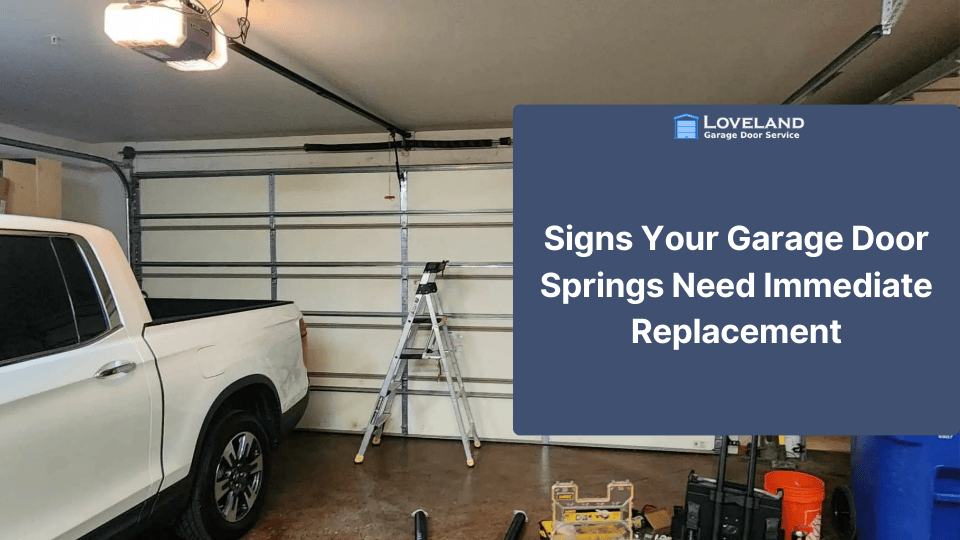
Signs Your Garage Door Springs Need Immediate Replacement

Garage Door Spring Replacement Cost In Colorado Greeely

The springs in your garage door system are the unsung heroes of daily convenience. They bear the enormous weight of the door—often several hundred pounds—converting tension into energy that allows the motor (or you) to lift and lower it with ease. However, garage door springs, whether they are torsion (mounted above the door) or extension (mounted along the sides of the track), have a finite lifespan. Ignoring the signs your garage door springs need immediate replacement is not just an inconvenience; it can be a serious safety hazard and lead to catastrophic damage to your opener system.

Recognizing the early warning signals is crucial for home safety and avoiding costly, complex repairs. This guide will walk you through the most critical indicators that your springs are failing and require professional attention right away. The primary keyword for this article is signs your garage door springs need immediate replacement.

The Catastrophic Indicator: A Loud, Explosive Sound

The most dramatic and undeniable sign your garage door springs need immediate replacement is the sound of one breaking.

  • The Noise: A torsion spring breaking releases its coiled tension instantaneously, resulting in a sound often described as a loud bang, a gunshot, or an explosion. The noise is sudden, shocking, and unmistakable.
  • What to Do: If you hear this sound, do not attempt to open or close the door. The spring is broken, and the door is now incredibly heavy and unstable. If the door is stuck open, it poses a risk of slamming shut. If it’s closed, the weight will overwhelm the opener motor if you try to activate it.

Visual Confirmation of a Broken Torsion Spring

If you’ve heard the sound, look up at the metal rod directly above the door. A healthy torsion spring will be a tightly wound coil. A broken spring will have a noticeable, several-inch gap in the coil—usually near the center. This visual confirmation is a clear sign your garage door springs need immediate replacement.

Performance Issues: The Door’s Struggle to Function

If you haven’t heard the “bang,” the next set of signs your garage door springs need immediate replacement are noticeable performance problems. These indicate that the springs are either fatigued, losing tension, or are severely damaged.

  • The Door Opens Slowly and Jerkily: When a spring begins to lose tension, the opener motor has to compensate for the increasing weight. The door will move slower than normal, often making a straining noise, and may appear to shudder or move unevenly on its tracks. Over time, this stress will burn out your motor.
  • The Door Falls Quickly When Closing: If you notice your door dropping rapidly or “slamming” shut instead of descending smoothly, it means the springs are not providing enough counterbalance. This is a hazardous situation, especially if children or pets are nearby.
  • The Door Stops Halfway: A severely weakened spring may allow the door to open a few feet before the motor can no longer overcome the imbalance, causing the door to stop and possibly reverse. This is often the point where homeowners incorrectly assume the problem is the opener itself, when the real culprit is the spring.

The Balance Test: A Critical Check

To confirm if your springs are functioning correctly (and not just your opener), perform the balance test:

  1. Close the garage door completely.
  2. Remove the red emergency release cord from the door opener.
  3. Lift the door manually until it is halfway open (around 4 feet).
  4. Release the door.

The Result: A properly tensioned door should remain stationary at the halfway point. If the door immediately starts to fall down or shoots up, it’s a definite sign your garage door springs need immediate replacement. Caution: If the door is unbalanced, be prepared to catch its weight.

Visible Wear and Tear on Components

Sometimes the warning signs are right in front of you, without needing to open or close the door.

  • Gaps in the Torsion Spring: As mentioned earlier, a break in the spring coil is the most obvious visual cue.
  • Worn Pulleys or Cables (Extension Springs): If you have extension springs (which run parallel to the horizontal tracks), check the cables and pulleys. Frayed, broken, or slack cables indicate that the system is under duress, usually from an underlying spring issue, and the springs may soon fail.
  • Rust and Corrosion: Springs that are heavily rusted will be significantly weaker and more prone to snapping. Rust introduces friction and accelerates material fatigue. Regular maintenance and a light coating of lubricant can prevent this, but heavy rust is a strong indication that the spring’s structural integrity is compromised.

Conclusion

Garage door springs are high-tension components designed to lift hundreds of pounds. Once you observe the signs your garage door springs need immediate replacement—a loud noise, slow or jerky operation, a failure to pass the balance test, or visible gaps—it is imperative to stop using the door immediately. Do not attempt to replace these springs yourself. Spring replacement requires specialized tools and expertise to handle the immense tension safely. Contacting a qualified professional is the only safe and reliable way to ensure your door system is restored to proper working order, protecting your family, your vehicle, and your investment in the garage door opener.

Heard the 'Bang' or Facing a Sagging Door?

Don’t risk injury or further damage to your opener. If you’ve noticed any signs your garage door springs need immediate replacement, call the experts. Contact us today for safe, fast, and professional garage door spring repair service!

Categories Garage Door Tips

The Most Common Garage Door Noises Explained (and How to Fix Them)

Most Common Garage Door Noises Issue in Residential area

It’s a sound many Loveland homeowners know well: the sudden, jarring symphony of groans, squeaks, and bangs from the garage door as you leave for work in the morning. While some noise is to be expected, loud or unusual sounds can be a sign that something isn’t right. Ignoring these noises can lead to bigger, more expensive problems down the road—or worse, a sudden door failure.

As your local garage door experts in Loveland, Colorado, we’ve heard every sound imaginable. We’ve put together a guide to help you identify the most common garage door noises, what they mean, and when it’s time to call a professional.

Squeaking or Squealing

This is arguably the most common and often easiest-to-fix garage door noise.

  • What It Means: A high-pitched squeak or squeal is almost always a sign of friction. It typically comes from rollers, hinges, or springs that lack proper lubrication. These metal parts are rubbing against each other or the tracks as the door moves.
  • How to Fix It: The solution is simple: lubrication. Using a quality silicone-based or lithium grease lubricant, apply a light coat to the hinges, rollers, springs, and bearings. Avoid using WD-40, as it’s a degreaser and can attract dirt, causing more problems in the long run. After lubricating, cycle the door a few times to work the lubricant in.

Grinding or Scraping

A grinding or scraping sound is a more serious indicator that something is physically off-kilter.

  • What It Means: This noise often points to a problem with the tracks or rollers. It could be caused by a bent track, a loose bolt, a broken roller, or a build-up of dirt and debris in the tracks. The metal parts are literally grinding against each other.
  • How to Fix It: First, visually inspect the tracks for any dents or bends. Clean out any debris with a rag. Make sure there are no cracks or breaks in the rollers. If you see a minor bend in the track or a loose bolt, you may be able to gently fix it yourself. However, if the track is significantly bent or the rollers are damaged, it’s a clear sign you need a professional repair to prevent the door from coming off its tracks entirely.

Popping or Banging

A loud popping or banging sound, especially when the door is opening or closing, is a major red flag.

  • What It Means: This is a classic sign of a broken garage door spring. The torsion springs above the door or the extension springs on the sides are under immense tension. When they snap, they release all that energy at once, creating a very loud bang that can sound like a gunshot. It could also indicate that the cables are tangled or binding as they unwind.
  • How to Fix It: DO NOT attempt to fix this yourself. Garage door springs are extremely dangerous. They are under high tension and can cause serious injury or even death if handled improperly. If you hear a loud bang and your door won’t open or feels incredibly heavy, your spring is likely broken. It’s time to call a professional immediately.

Rattling

A rattling noise can sound like a series of small, rapid bangs and is usually a sign of something being loose.

  • What It Means: This noise is often caused by loose nuts, bolts, or screws on the door’s hardware, particularly the hinges. The vibrations from the door’s movement cause the loose components to rattle.
  • How to Fix It: Go through the door’s hardware with a socket wrench and a screwdriver. Gently but firmly tighten all the nuts and bolts you can find, especially on the hinges and the brackets holding the tracks to the wall. Overtightening can strip the screws, so be careful.

When to Call a Pro

While simple lubrication and tightening can fix many garage door noises, some problems require the expertise of a professional. If you live in the Loveland, Colorado area, you should call us if:

  • The noise is from the springs or cables. These are high-tension parts and should only be handled by a trained technician.
  • The door is crooked, uneven, or comes off its tracks.
  • The noise persists even after you’ve lubricated and tightened all the parts.
  • You hear a loud bang or snap and the door no longer works.

Don’t ignore the warning signs. Addressing a garage door noise early can prevent a major malfunction and ensure the safety of your family. If your garage door is making a symphony of sounds, give us a call today (970) 367-8600 for a professional inspection and repair. We’ll get your garage door running smoothly and quietly again.

Categories Garage Door Tips

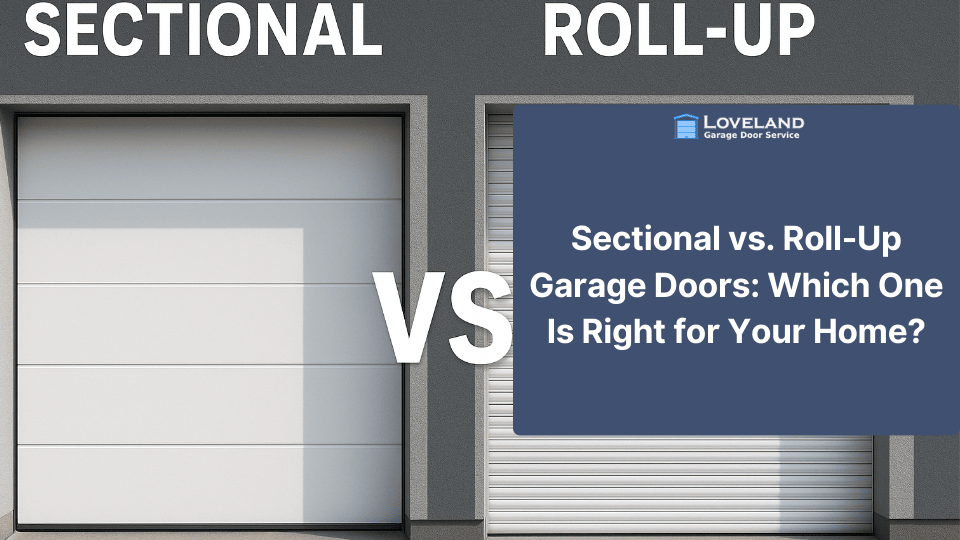
Sectional vs. Roll-Up Garage Doors: Which One Is Right for Your Home?

Deciding between a sectional and roll-up garage door?

Choosing a new garage door is a significant decision for any homeowner. Not only does it impact the curb appeal of your property, but it also plays a crucial role in security, insulation, and daily convenience. Two of the most popular and modern choices are sectional garage doors and roll-up garage doors. While both offer a sleek, vertical-opening design that saves space, they operate and are constructed in fundamentally different ways. Understanding these differences is key to making the right choice for your home, your budget, and your lifestyle. Let’s compare these two popular garage door styles side-by-side to determine which is the best fit for you.

Sectional Garage Doors: The Modern Classic

Sectional garage doors are the most common type of residential garage door in the United States. They are made of several hinged panels that lift vertically and then roll back along horizontal tracks, resting parallel to the garage ceiling when open.

Key Advantages of Sectional Doors
  • Superior Aesthetics and Customization: Sectional doors offer a vast range of design options. Because they are made of large, distinct panels, they can be customized with various colors, textures, and decorative hardware. You can also easily incorporate windows, adding natural light and a unique touch to your home’s exterior. This design flexibility makes them an excellent choice for enhancing your home’s curb appeal.
  • Excellent Insulation: The panel-based construction of sectional doors makes them ideal for insulation. The thick, continuous sections can be filled with insulation materials like polyurethane or polystyrene foam, creating a highly effective thermal barrier. This is a major plus if your garage is attached to your home or if you use it as a workshop, helping to maintain a comfortable temperature and reduce energy costs.
  • Enhanced Security: The rigid, multi-panel construction and the tight fit within the tracks make sectional doors very secure. There are no easy access points for prying, and the system is inherently robust against forced entry.
  • Maximized Drive-Through Space: Since sectional doors retract fully into the garage, they don’t have a protruding mechanism that a traditional up-and-over door might. This allows you to use the entire width and height of the garage opening, which is particularly useful for larger vehicles like SUVs.

Roll-Up Garage Doors: The Space-Saving Solution

Also known as roller doors or coiling doors, roll-up garage doors are composed of a curtain of narrow, interconnected slats that coil up into a barrel or drum above the door opening. This design is highly efficient, especially in tight spaces.

Key Advantages of Roll-Up Doors
  • Ultimate Space Efficiency: This is the most significant advantage of a roll-up door. The coiling mechanism requires minimal headroom and no horizontal tracks, leaving the ceiling space in your garage completely clear. This is an ideal solution if your garage has a low ceiling, or if you have overhead storage, plumbing, or lighting fixtures that would interfere with sectional door tracks.
  • Simpler Mechanism and Maintenance: With fewer moving parts than a sectional door, roll-up doors are generally low-maintenance. They don’t have the complex springs, hinges, and rollers that require regular lubrication and adjustment. This simplicity can translate to fewer potential issues and easier upkeep over time.
  • Durability and Security: Roll-up doors, particularly those made of double-skinned aluminum or steel, are incredibly durable. The curtain-like design and robust construction make them difficult to pry open. Many models are equipped with secure locking mechanisms that further enhance their security.

Direct Comparison: Key Factors to Consider

Now that we’ve looked at the individual benefits, let’s compare them on key decision-making factors.

  • Appearance & Design: If style and customization are your top priority, a sectional garage door is the clear winner. Its panel designs, finishes, and window options allow for a more personalized and high-end look that can significantly boost curb appeal. Roll-up doors have a more industrial, corrugated appearance, with fewer design variations.
  • Space Requirements: For garages with limited headroom or those that require the ceiling space for storage or other installations, the roll-up door is the superior choice. Its compact coiling mechanism saves valuable overhead space. A sectional door, while it doesn’t swing out, still needs clear ceiling space for the tracks and door panels.
  • Insulation & Energy Efficiency: Sectional doors generally offer better insulation due to their thick, foam-filled panels and tight perimeter seals. While insulated roll-up doors are available, the small gaps between the slats can make them less thermally efficient than a well-insulated sectional door.
  • Cost: The initial cost can vary widely based on materials, size, and features. Generally, a basic roll-up door might have a lower starting price, but a high-end, insulated model can be comparable or even more expensive than a sectional door. When comparing sectional vs. roll-up garage door costs, it’s important to get quotes for similar specifications to make an accurate decision.
  • Noise Level: Modern sectional doors with nylon rollers are known for their quiet operation. Roll-up doors can sometimes be noisier due to the coiling action of the slats, although newer models are designed to minimize this.

Conclusion

The choice between a sectional garage door and a roll-up garage door ultimately depends on your specific needs and priorities.

  • Choose a Sectional Garage Door if: You want a wide range of aesthetic options to match your home’s style, excellent insulation, and superior security. This is often the best choice for residential properties where curb appeal and energy efficiency are key considerations.
  • Choose a Roll-Up Garage Door if: You have limited headroom in your garage, prioritize maximum space efficiency, and prefer a low-maintenance, simple mechanism. This is a perfect solution for garages with obstructions on the ceiling or for homeowners who value practicality above all else.

Both door types are excellent modern alternatives to traditional models. By weighing the pros and cons of each, you can confidently select the perfect garage door that will not only protect your home but also add to its functionality and value for years to come.

Call to Action:

Still unsure which garage door is right for you? Our team of experts can provide a personalized consultation to help you compare sectional vs. roll-up garage doors and find the ideal fit for your home and budget. Contact us today for a free, no-obligation quote!

Categories Garage Door Tips

The Future of Garage Doors: AI, IoT, and Smart Automation

A smart garage door featuring AI and IoT technology, showing icons for Wi-Fi connectivity, a smartphone, and a security camera

The humble garage door, once a purely mechanical gateway to our homes, is undergoing a profound transformation. No longer just a heavy slab that goes up and down, it’s rapidly evolving into a sophisticated, interconnected component of the smart home ecosystem. Driven by advancements in Artificial Intelligence (AI), the Internet of Things (IoT), and smart automation, the future of garage doors promises unprecedented levels of convenience, security, and energy efficiency.

Imagine a garage door that anticipates your arrival, grants access to delivery drivers without you being home, or even diagnoses its own problems before they become critical. This isn’t science fiction; it’s the near future, and it’s being powered by intelligent technologies that are redefining how we interact with our homes. Let’s delve into the exciting innovations shaping the next generation of smart garage doors.

Redefining Convenience and Control with Smart Garage Doors

The integration of IoT and AI into garage door systems is fundamentally changing how we experience access to our homes. These smart garage doors offer far more than just remote operation.

Seamless Connectivity Through IoT

An Internet of Things-based smart garage door revolution is underway. IoT enables garage door openers and related sensors to connect to your home’s Wi-Fi network and communicate with other smart devices.

  • Smartphone Control: This is perhaps the most immediate benefit. Smart garage door openers allow you to open or close your garage from anywhere. Forgot if you closed the door? You can keep your mind at ease by checking your phone quickly.
  • Voice Assistant Integration: Control your garage door with simple voice commands through devices like Amazon Alexa or Google Assistant. “Alexa, open the garage door” eliminates the need for physical remotes or even your phone when your hands are full.
  • Geofencing: This intelligent feature allows your garage door to automatically open as your car approaches your driveway and close once you’ve safely entered or left. It leverages your smartphone’s location services for a truly hands-free experience, learning your patterns and making your daily routine smoother.
Enhanced Security Features

Beyond convenience, the future of garage doors significantly elevates home security. Smart automation can make protection more proactive and intelligent.

  • Real-time Alerts and Monitoring: Receive instant notifications on your phone if your garage door opens unexpectedly or is left open for an extended period. Integrated cameras can provide live video feeds, allowing you to visually verify who is entering or exiting.
  • Temporary Access Codes: Grant temporary, time-sensitive access to friends, family, or delivery services without sharing physical keys or permanent codes. This is particularly useful for package deliveries, ensuring items are securely placed inside your garage rather than left on your porch.
  • Intrusion Detection: Future garage doors might incorporate advanced sensors that can differentiate between a car pulling in and an attempted forced entry, triggering alarms or alerting authorities instantly.

The Role of AI in Predictive Maintenance and Optimization

While IoT provides the connectivity, Artificial Intelligence is what makes garage doors truly “smart.” AI moves beyond simple automation to enable predictive capabilities and intelligent decision-making.

Predictive Maintenance and Diagnostics

AI algorithms can analyze data from various sensors within the garage door system—motor performance, spring tension, roller movement, and opener cycles.

  • Early Problem Detection: Instead of waiting for a breakdown, AI can detect subtle changes in performance that indicate wear and tear on components like springs, cables, or the opener motor. It can then alert you and even schedule a service appointment before a major malfunction occurs.
  • Optimized Performance: AI can learn your usage patterns and optimize the door’s operation for smoother, quieter, and more energy-efficient movement, extending the lifespan of the entire system.
  • Self-Healing Capabilities: In the long term, AI-powered systems might even be able to perform minor self-adjustments or initiate automated fixes for very small issues, similar to how modern cars diagnose their own engine problems.
Energy Efficiency and Climate Control

Smart garage doors will play a larger role in your home’s overall energy management.

  • Smart Insulation: Combined with advanced insulation materials, smart sensors can monitor temperature and humidity within the garage. If connected to a smart thermostat, they could adjust heating or cooling to maintain optimal conditions, reducing energy waste.
  • Sunlight Optimization: Future systems could potentially integrate with weather forecasts to know when to open slightly for ventilation or close fully to prevent heat transfer, optimizing the garage environment.
Beyond the Horizon: What Else to Expect

The innovation in smart garage doors is far from over. Here are some glimpses into future possibilities:

  • Integrated Drone Delivery Pads: Imagine a dedicated, secure landing zone for drones that can automatically open and close your garage door to receive packages.
  • Enhanced Vehicle Integration: Deeper integration with smart cars could mean your garage door is seamlessly linked to your car’s navigation and home systems, making arrivals and departures even smoother.
  • Adaptive Security Protocols: AI could learn your family’s routines and automatically adjust security settings, locking down the garage more tightly when you’re away or at night.

Conclusion: A Smart Investment in Your Home's Future

The evolution of garage doors from mere entry points to intelligent home assistants is well underway. The fusion of AI, IoT, and smart automation is bringing unparalleled convenience, robust security, and improved energy efficiency to this often-underestimated part of our homes. Investing in a smart garage door is not just an upgrade; it’s a step into the future of connected living.

Call to Action:

Are you ready to experience a new level of convenience and security at home? Explore the latest smart garage door solutions available today and transform your home! If you’re interested in integrating AI and IoT into your garage, reach out to a smart home specialist.